Why start here
Every module on this site — registration, vitals, examination, investigations, diagnosis, drug administration — is a station on one continuous journey. Before zooming into any single station, it helps to see the whole route a patient actually walks, and the point where that route splits in two: one path for a patient who is critical or acute, and a different, calmer path for one who is stable and routine. Every module that follows in this register sits somewhere on this map.
The journey, step by step
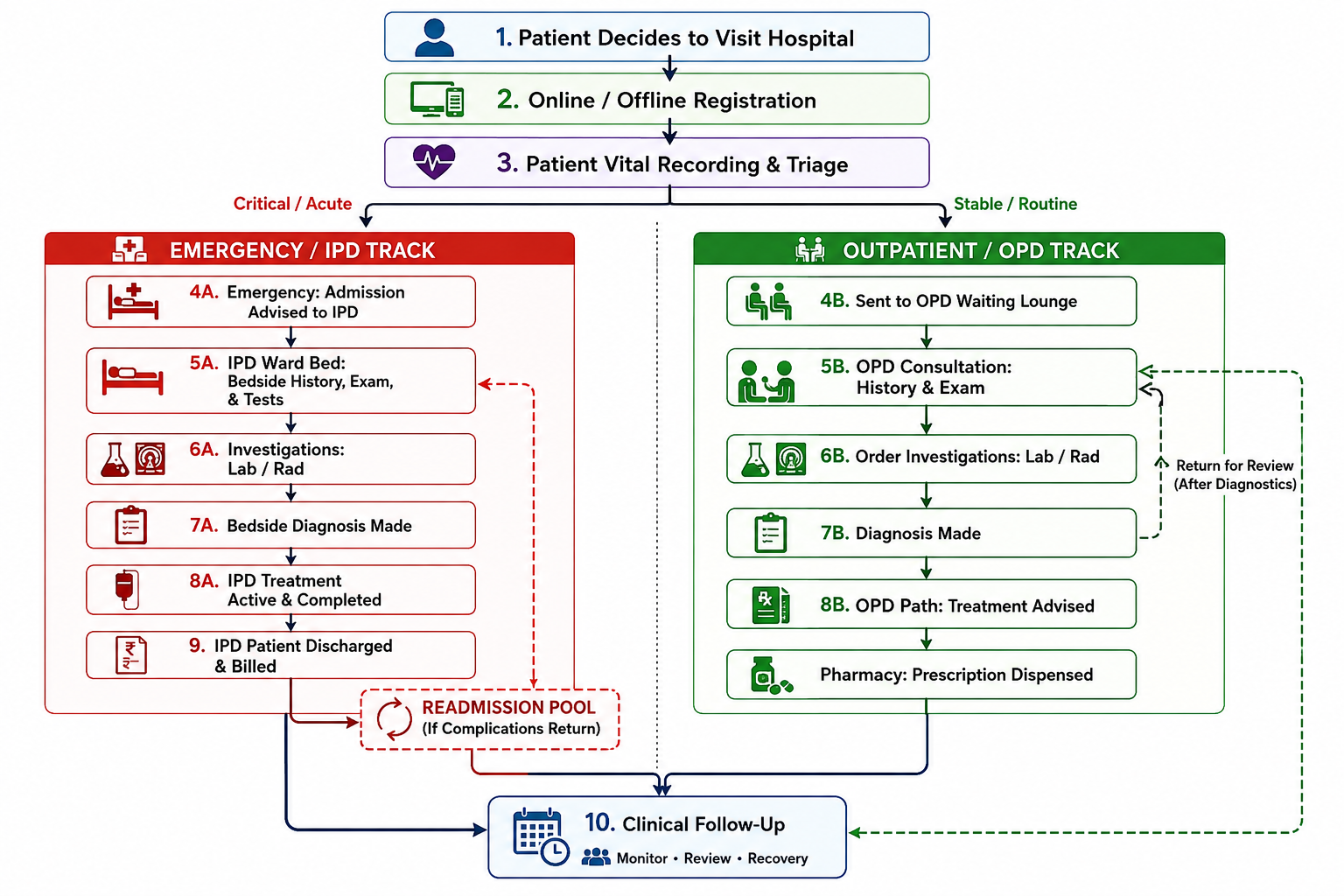
Reading the map
The first three steps are common to every patient, regardless of what brings them in: the decision to come to the hospital, registration (online or offline), and vital recording with triage. Triage is the fork in the road — it decides whether a patient is critical/acute and needs the Emergency/IPD track, or stable/routine and can be managed on the Outpatient/OPD track.
The two tracks mirror each other in structure — admission or waiting, consultation and examination, investigations, diagnosis, treatment — but differ in pace, setting, and stakes. The Emergency/IPD track ends in discharge and billing, with a readmission pool if complications bring the patient back. The Outpatient/OPD track ends at the pharmacy, but includes its own loop — after diagnostics come back, the patient may be returned for review to the same consultation before treatment is finalised. Both tracks converge on the same last step: Clinical Follow-Up — monitoring, review, and recovery — closing the loop for every patient, whichever path brought them there.
Where this site's modules fit
Steps 2 and 3 — registration and vitals/triage — are the subject of the Patient Registration, Telephone-based OPD Registration, and IoT Vitals Capture Kiosk modules. Steps 5A/5B and 7A/7B — history, examination, and diagnosis — map onto the Clinical Examination Templates and Final Diagnosis modules. Step 8 — treatment — is where the AI Agent Based Drug Administration Support Module sits. And the full picture of what AI could do across every one of these steps is mapped out in AI Agents for Hospitals. The System Architecture module takes this same journey and re-frames it around the underlying data record, rather than the patient's own path through the building.