Why name it this way
Every project on this site so far has been built as its own standalone tool. In practice they're stations on the same patient journey, each owning one part of the record before handing the patient — and the data — to the next. Naming them as modules makes that handoff explicit, and gives the two investigation modules that don't exist yet (Histopathology, Radiology) a defined place to slot into later.
The patient journey
Registration Module
Patient registers at the counter or online.
Built — Project 1Vitals IoT Module
Demographics, chief complaints, and vitals captured at the kiosk — printed on the registration slip.
Proposal — Project 2Doctor's Exam Module
Clinical history and examination, as in the department template. Ends in Provisional Diagnosis 1.
Built — Project 3Blood INV Module
Biochemistry, Haematology, and Pathology (blood-based). Results feed into Provisional Diagnosis 2 — which can differ from Diagnosis 1.
Data modelled — Project 4Histopathology Module
Tissue / biopsy specimens, reported separately from blood investigations.
Not yet builtRadiology Module
Imaging reported independently, reaching its own Radiological Diagnosis.
Not yet builtCombined Report
Radiological Diagnosis + Diagnosis after blood investigations, brought together.
Decision pointFinal Diagnosis
Made by the doctor, reconciling all three inputs — clinical, blood/tissue, and radiological.
Doctor's callThe point of splitting it up
The diagnosis isn't a single event — it's revised at least twice: once from history and examination alone, once after blood (and eventually tissue) results come back, and once more when radiology is combined in. Keeping each module's output as its own labelled field, rather than overwriting a single "diagnosis" box, is what makes it possible to later ask questions like how often does the final diagnosis differ from the provisional one — which is exactly the kind of question a structured, module-tagged record (like the sample dataset) is built to answer.
Why every module is a structured checklist, not free text
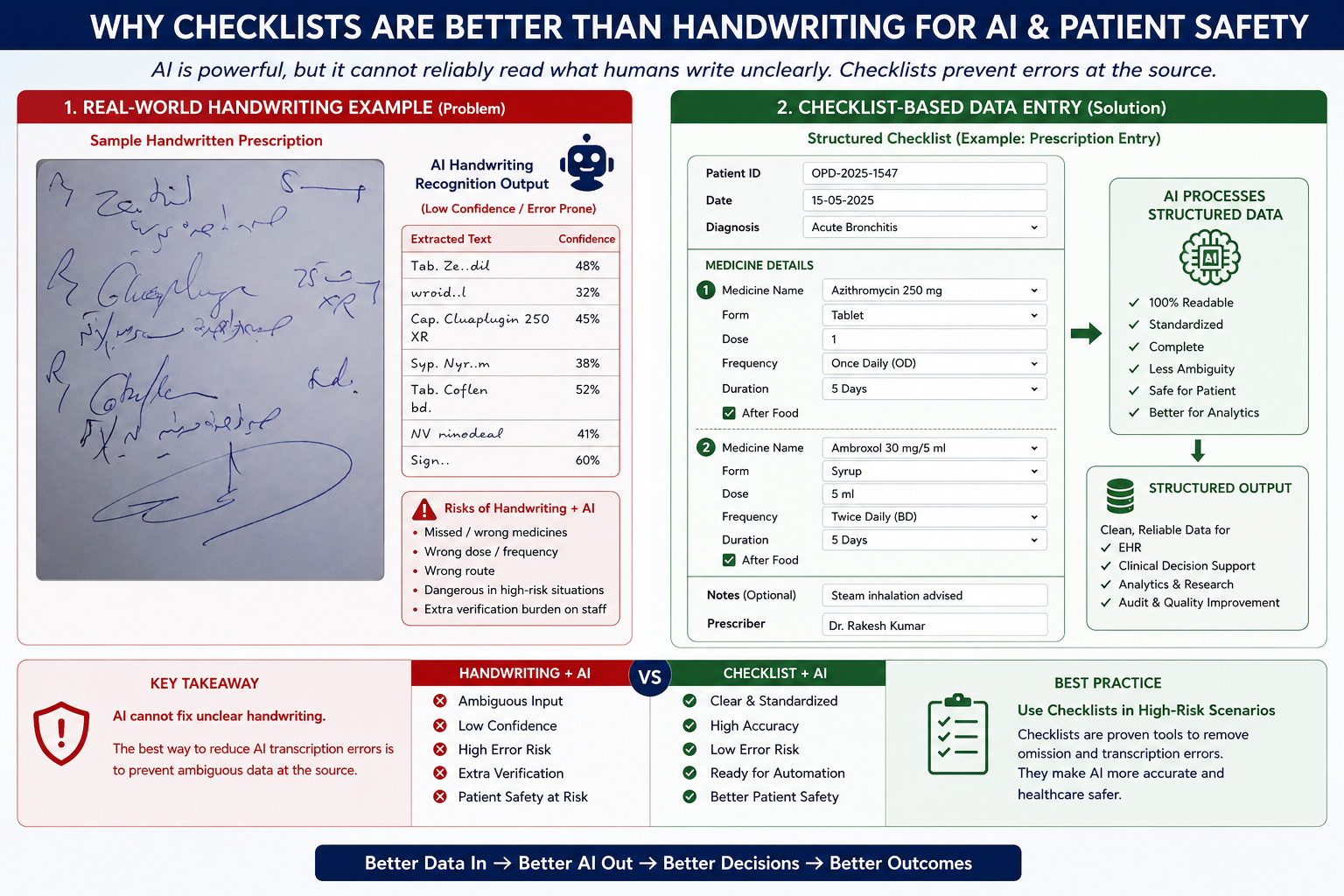
This is the same principle behind every module on this site being built as a structured form or checklist rather than a free-text or handwritten note. AI handwriting recognition can only guess at what a doctor has scrawled — the example above shows extraction confidence as low as 32–52% on a real prescription, with real consequences: missed or wrong medicines, wrong dose or frequency, wrong route. A structured checklist removes the ambiguity at the source. Every field — Patient ID, Diagnosis, Medicine Name, Dose, Frequency, Duration — is captured as a discrete, standardised value the moment it's entered, so there's nothing left for an AI model to misread downstream. That's precisely why the Clinical Examination Templates, the RVC Slip, and the Drug Administration Support Module are all built as checklists and dropdowns rather than free-text boxes: better data in means better AI out, better decisions, and better outcomes.