Where this fits
This module starts right after Final Diagnosis. The diagnosis the doctor has confirmed — not the model's ranked list, the doctor's own conclusion — is what a prescription is written against. The AI agent's job begins once a nurse or clinician enters or verifies that prescription, checking it before the drug ever reaches the patient.
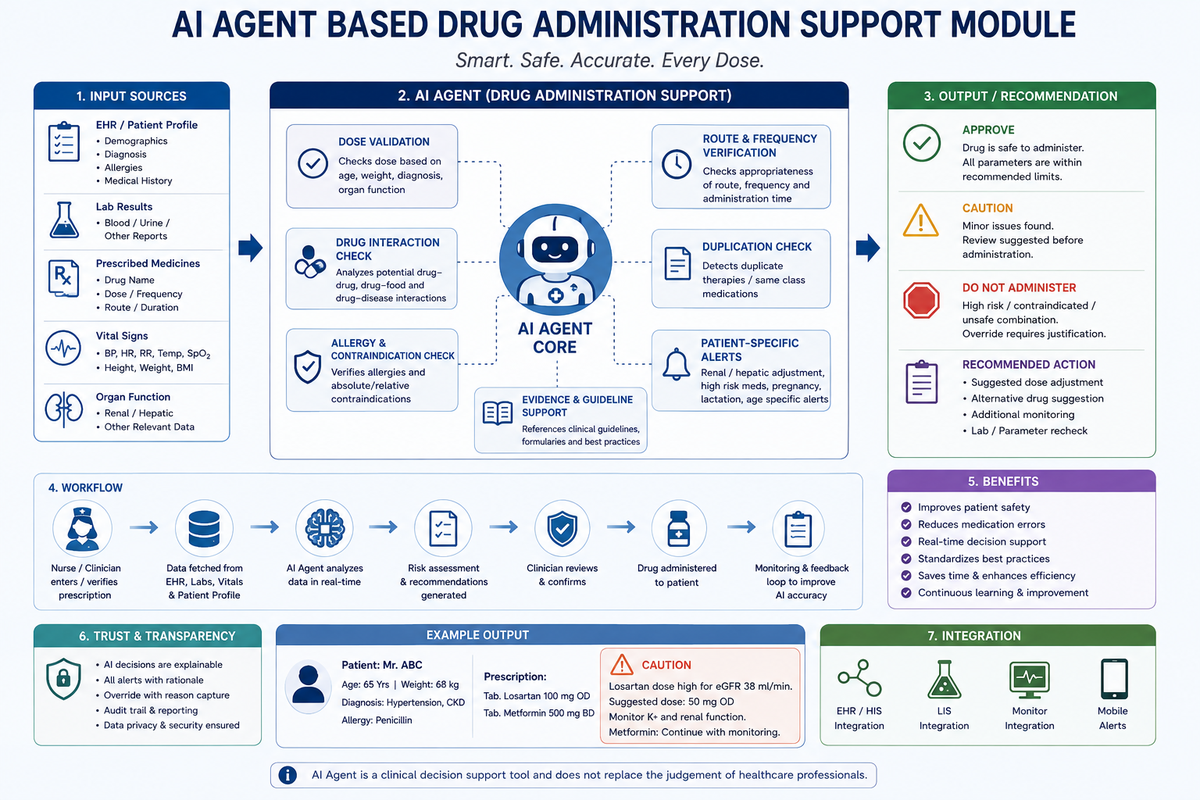
What feeds the AI agent
- EHR / Patient Profile — demographics, diagnosis, allergies, medical history.
- Lab Results — blood, urine, and other reports already in the record.
- Prescribed Medicines — drug name, dose and frequency, route and duration, as written by the doctor.
- Vital Signs — BP, HR, RR, temperature, SpO2, height, weight, BMI — the same fields captured at registration and the vitals kiosk.
- Organ Function — renal and hepatic function, and any other relevant data affecting how a drug should be dosed.
What the AI agent checks
- Dose validation — checks the dose against age, weight, diagnosis, and organ function.
- Drug interaction check — analyses potential drug–drug, drug–food, and drug–disease interactions.
- Allergy & contraindication check — verifies allergies and absolute or relative contraindications.
- Route & frequency verification — checks that the route, frequency, and administration time are appropriate.
- Duplication check — detects duplicate therapies or two drugs from the same class.
- Patient-specific alerts — renal or hepatic dose adjustment, high-risk medicines, pregnancy, lactation, and age-specific alerts.
- Evidence & guideline support — references clinical guidelines, formularies, and best practices behind each check.
What comes back
- Approve — drug is safe to administer; all parameters are within recommended limits.
- Caution — minor issues found; review the suggestion before administration.
- Do Not Administer — high risk, contraindicated, or unsafe combination; an override requires justification.
- Recommended action — a suggested dose adjustment, an alternative drug, additional monitoring, or a lab/parameter recheck, alongside whichever of the three verdicts above applies.
How it fits into the workflow
- Nurse or clinician enters or verifies the prescription.
- Data is fetched from the EHR, labs, vitals, and patient profile.
- The AI agent analyses all of it in real time.
- A risk assessment and recommendations are generated.
- The clinician reviews the output and confirms.
- The drug is administered to the patient.
- A monitoring and feedback loop feeds back in, improving the AI agent's accuracy over time.
Example output
- Patient
- Mr. ABC — Age 65 yrs, Weight 68 kg
- Diagnosis
- Hypertension, CKD
- Allergy
- Penicillin
- Prescription
- Tab. Losartan 100 mg OD; Tab. Metformin 500 mg BD
Caution: Losartan dose is high for an eGFR of 38 ml/min — suggested
dose 50 mg OD. Monitor potassium and renal function. Metformin: continue, with
monitoring.
Benefits
- Improves patient safety
- Reduces medication errors
- Real-time decision support
- Standardises best practices
- Saves time and enhances efficiency
- Continuous learning and improvement
Integration
Trust, transparency & the doctor's final word
- AI decisions are explainable — every alert comes with its rationale, not a bare warning.
- An override is always possible, but the reason for it is captured.
- A full audit trail and reporting sit behind every check.
- Data privacy and security are treated as non-negotiable.
As with Final Diagnosis before it: this is a clinical decision support tool. It does not replace the judgement of healthcare professionals — the clinician always reviews the output and confirms before the drug is administered.