The full picture
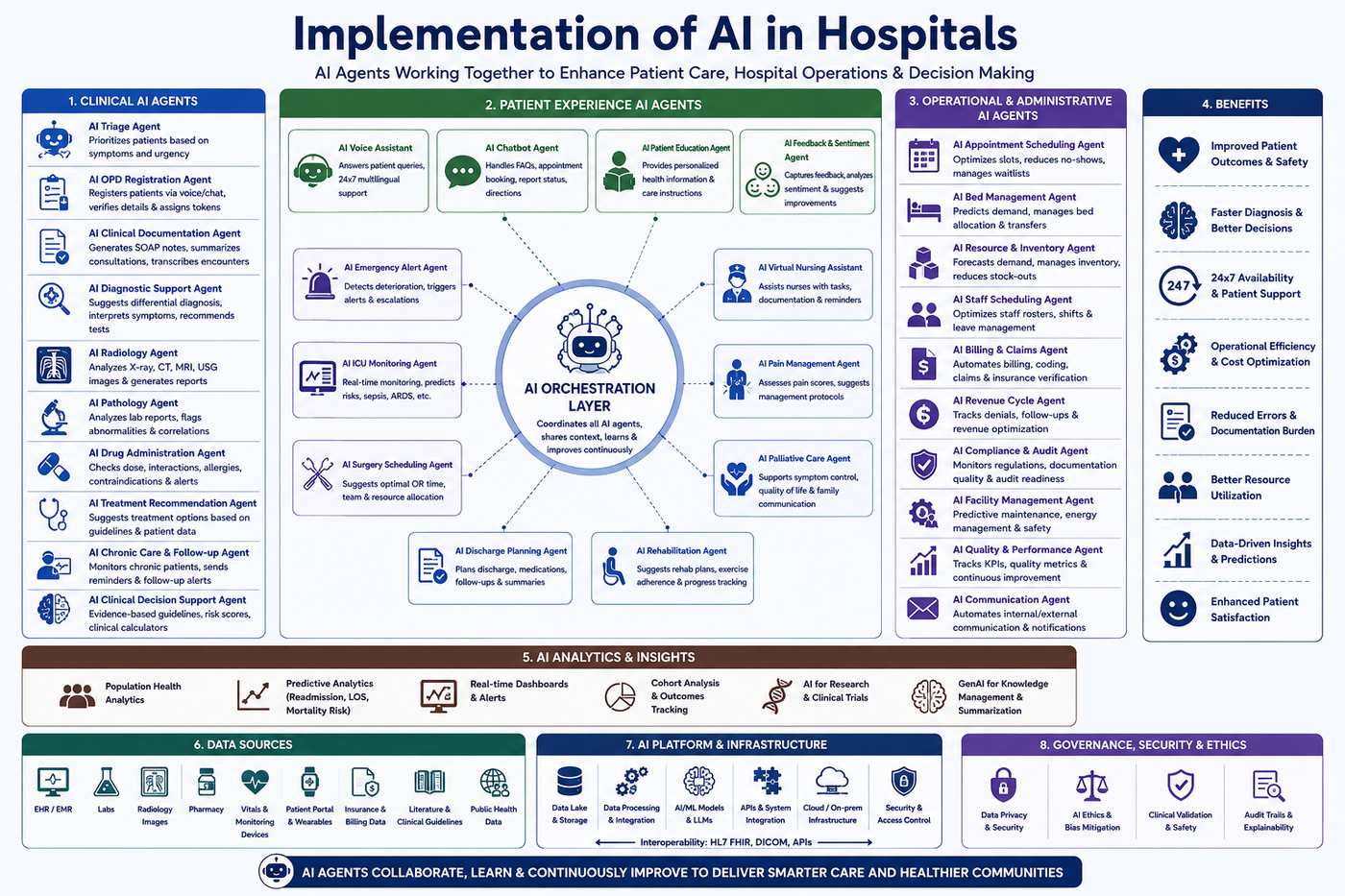
1. Clinical AI agents
Agents working directly on the clinical record — several of these are exactly the modules already built on this site.
- AI Triage Agent — prioritises patients based on symptoms and urgency.
- AI OPD Registration Agent — registers patients via voice or chat, verifies details, and assigns tokens.
- AI Clinical Documentation Agent — generates SOAP notes, summarises consultations, transcribes encounters.
- AI Diagnostic Support Agent — suggests a differential diagnosis, interprets symptoms, recommends tests.
- AI Radiology Agent — analyses X-ray, CT, MRI, and USG images and generates reports.
- AI Pathology Agent — analyses lab reports, flags abnormalities and correlations.
- AI Drug Administration Agent — checks dose, interactions, allergies, contraindications and alerts.
- AI Treatment Recommendation Agent — suggests treatment options based on guidelines and patient data.
- AI Chronic Care & Follow-up Agent — monitors chronic patients, sends reminders and follow-up alerts.
- AI Clinical Decision Support Agent — evidence-based guidelines, risk scores, clinical calculators.
2. Patient experience AI agents & the orchestration layer
At the centre of the diagram sits the AI Orchestration Layer — it coordinates every agent on this page, shares context between them so a patient isn't re-asked the same thing twice, and is the layer that learns and improves continuously. Around it sit the agents a patient actually interacts with, plus the ones supporting them behind the scenes:
- AI Voice Assistant — answers patient queries, 24x7 multilingual support.
- AI Chatbot Agent — handles FAQs, appointment booking, report status, directions.
- AI Patient Education Agent — provides personalised health information and care instructions.
- AI Feedback & Sentiment Agent — captures feedback, analyses sentiment, suggests improvements.
- AI Emergency Alert Agent — detects deterioration, triggers alerts and escalations.
- AI ICU Monitoring Agent — real-time monitoring, predicts risks such as sepsis or ARDS.
- AI Surgery Scheduling Agent — suggests optimal OR time, team, and resource allocation.
- AI Discharge Planning Agent — plans discharge, medications, follow-ups and summaries.
- AI Rehabilitation Agent — suggests rehab plans, tracks exercise adherence and progress.
- AI Virtual Nursing Assistant — assists nurses with tasks, documentation and reminders.
- AI Pain Management Agent — assesses pain scores, suggests management protocols.
- AI Palliative Care Agent — supports symptom control, quality of life, and family communication.
3. Operational & administrative AI agents
The agents that keep the hospital itself running, not just the clinical encounter.
- AI Appointment Scheduling Agent — optimises slots, reduces no-shows, manages waitlists.
- AI Bed Management Agent — predicts demand, manages bed allocation and transfers.
- AI Resource & Inventory Agent — forecasts demand, manages inventory, reduces stock-outs.
- AI Staff Scheduling Agent — optimises staff rosters, shifts, and leave management.
- AI Billing & Claims Agent — automates billing, coding, claims and insurance verification.
- AI Revenue Cycle Agent — tracks denials, follow-ups, and revenue optimisation.
- AI Compliance & Audit Agent — monitors regulations, documentation quality, audit readiness.
- AI Facility Management Agent — predictive maintenance, energy management, and safety.
- AI Quality & Performance Agent — tracks KPIs, quality metrics, continuous improvement.
- AI Communication Agent — automates internal and external communication and notifications.
4. Benefits
- Improved patient outcomes & safety
- Faster diagnosis & better decisions
- 24x7 availability & patient support
- Operational efficiency & cost optimisation
- Reduced errors & documentation burden
- Better resource utilisation
- Data-driven insights & predictions
- Enhanced patient satisfaction
5. AI analytics & insights
- Population health analytics
- Predictive analytics — readmission, length of stay, mortality risk.
- Real-time dashboards & alerts
- Cohort analysis & outcomes tracking
- AI for research & clinical trials
- GenAI for knowledge management & summarisation
6. Data sources
Everything above depends on data actually flowing in from these sources — several of which are exactly what the earlier modules on this site are built to capture cleanly.
7. AI platform & infrastructure
- Data Lake & Storage
- Data Processing & Integration
- AI/ML Models & LLMs
- APIs & System Integration
- Cloud / On-prem Infrastructure
- Security & Access Control
Interoperability across all of it runs on standard rails: HL7 FHIR, DICOM, and APIs — so this isn't a closed system tied to one vendor's format.
8. Governance, security & ethics
- Data Privacy & Security
- AI Ethics & Bias Mitigation
- Clinical Validation & Safety
- Audit Trails & Explainability
This panel underpins every other one on this page — it's the same governance thread that runs through Final Diagnosis and Drug Administration individually (the doctor as final authority, explainable alerts, an audit trail behind every check), applied at the scale of a whole hospital's worth of agents rather than one module at a time.
What ties it together
AI agents collaborate, learn, and continuously improve to deliver smarter care and healthier communities. Everything built on this site so far — Registration, the Vitals Kiosk, Telephone Registration, the RVC Slip, Clinical Examination Templates, the Sample Dataset, Final Diagnosis, and Drug Administration — is a working slice of the Clinical AI Agents and Data Sources panels above. This page is the map of where the rest could go.