One Patient. Multiple Queues.
A patient's journey through an Outpatient Department (OPD) rarely involves a single queue.
A patient may begin by waiting for registration, followed by a queue for consultation. If investigations are advised, the patient may encounter additional queues for blood collection, X-ray, CT, MRI, ultrasound, or other diagnostic services. After the investigations, the patient may need to wait again for report collection, return to the doctor for review, and finally stand in another queue at the pharmacy.
Thus, what appears to be a single OPD visit is actually a sequence of multiple waiting points distributed across different departments and service counters.
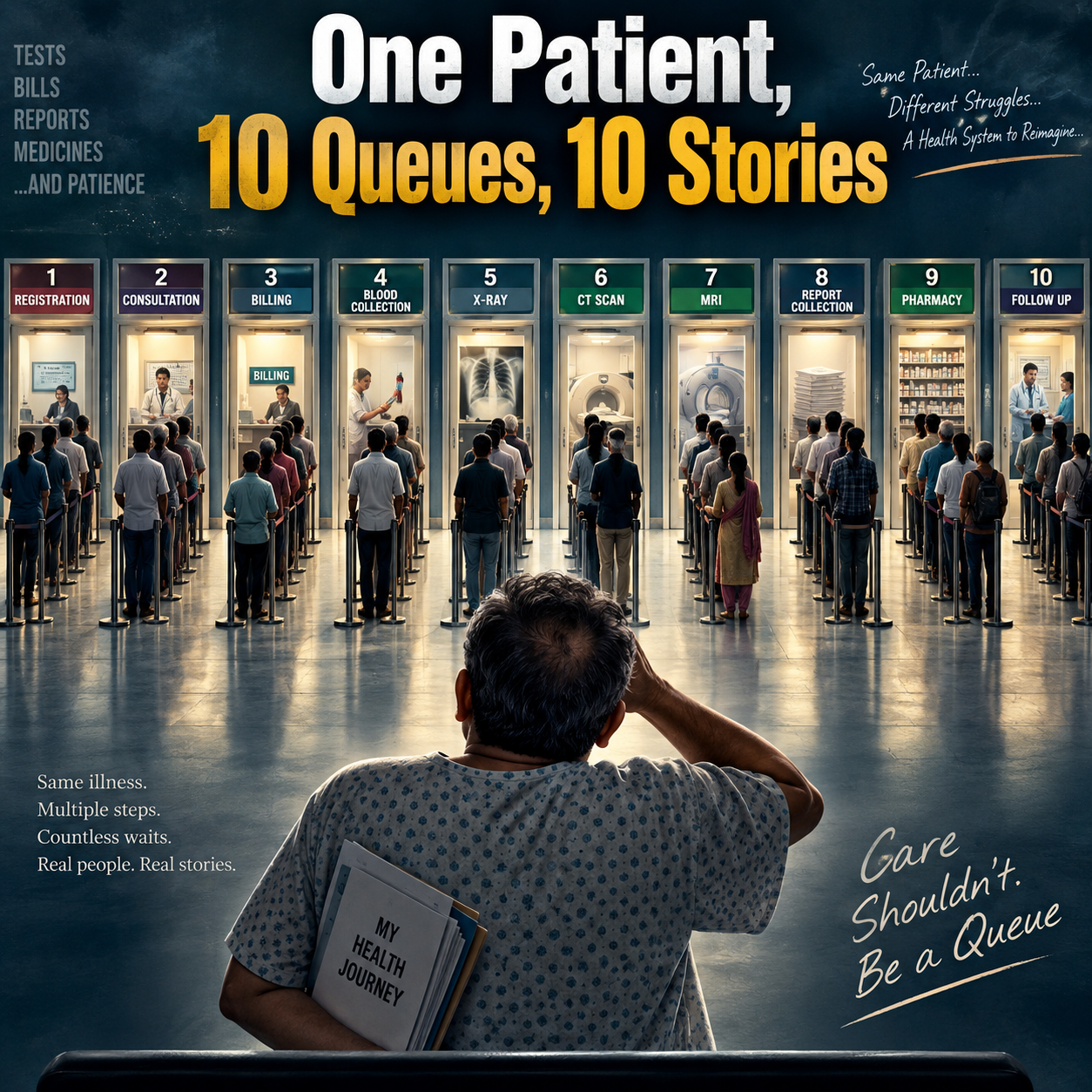
The Patient's Journey Through the Queues
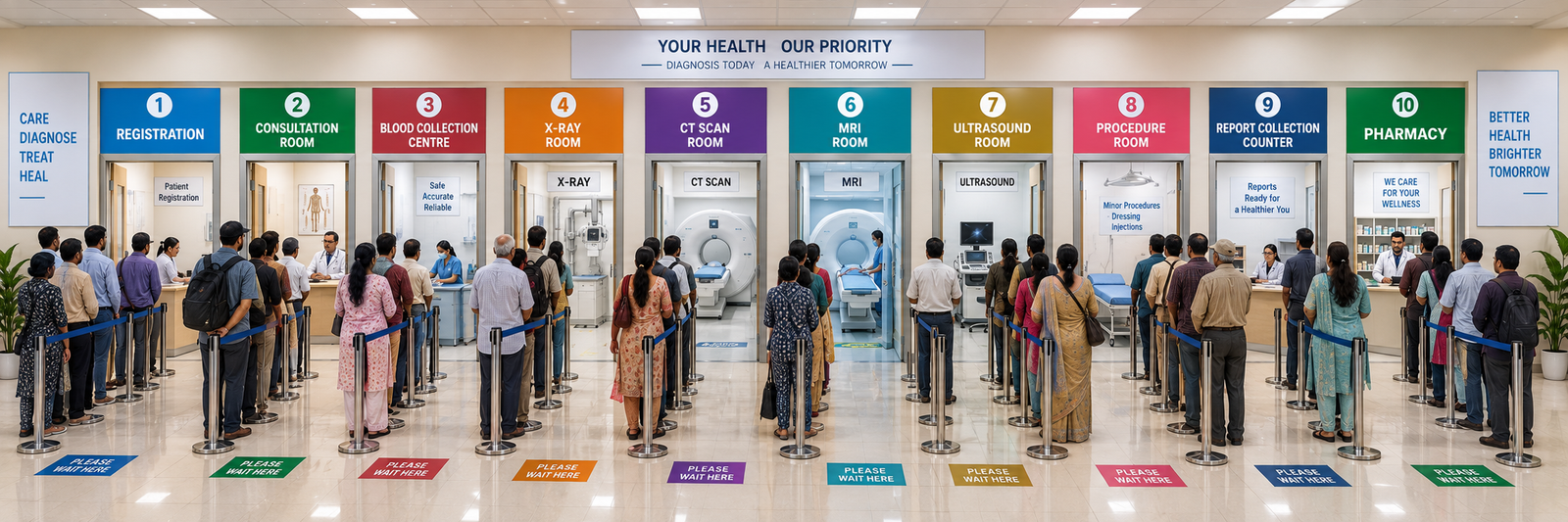
In a typical OPD, the patient may pass through several stations:
- Registration — queue for registration or appointment processing
- Consultation — queue to meet the doctor
- Blood Collection — queue for laboratory investigations
- X-ray — queue for radiological examination
- CT Scan — queue for CT imaging
- MRI — queue for MRI examination
- Ultrasound — queue for ultrasound examination
- Procedure Room — queue for procedures, dressings, injections, or other interventions
- Report Collection — queue to obtain investigation reports
- Pharmacy — queue for prescription processing and dispensing
Depending on the patient's clinical requirements, not every patient visits every station. However, a single patient may encounter several of these queues during the same episode of care.
The Problem Is Not One Queue
The fundamental problem is therefore not merely the length of an individual queue.
It is the fragmentation of the patient's journey into multiple independent queues.
Each department typically manages its own queue. Registration manages registration. Radiology manages imaging. The laboratory manages blood collection. The pharmacy manages dispensing.
From the perspective of individual departments, these queues may appear efficient.
From the perspective of the patient, however, they form one continuous journey—with repeated waiting, movement between departments, uncertainty about what comes next, and considerable loss of time.
One Patient — Multiple Waiting Events
Consider a patient who arrives at the hospital for a consultation.
The patient may:
The clinical pathway may be appropriate, but the patient experience can become dominated by waiting.
The patient's time is consumed not only by the actual healthcare services being provided, but also by the intervals between them.
Why This Matters for AI
This is where the concept of AI-enabled hospital workflow management becomes relevant.
Every queue generates data:
- Time of arrival
- Registration time
- Time of service
- Waiting time
- Service duration
- Number of patients waiting
- Patient movement between departments
- Investigation requirements
- Report availability
- Return-for-review requirements
- Pharmacy demand
When these data points are captured and connected across the patient's journey, the hospital can begin to understand how patients actually move through the system.
AI can potentially use this information to predict demand, estimate waiting times, identify bottlenecks, optimise sequencing, balance workloads, and improve patient flow.
The objective is not simply to make individual queues faster.
The larger objective is to reduce unnecessary waiting across the entire patient journey.
From Queue Management to Patient Flow Management
Traditional hospital systems tend to manage queues department by department.
An intelligent hospital should increasingly be able to manage the patient journey as a whole.
Instead of asking:
"How many patients are waiting at this counter?"
the system should also be able to ask:
"Where is this patient in their journey, what needs to happen next, and how can the remaining journey be completed with the least unnecessary waiting?"
This represents a shift from Queue Management to Patient Flow Management.
The AI Opportunity
The OPD queue is therefore an important starting point for hospital AI implementation.
- The queue is visible.
- The waiting time is measurable.
- The patient journey is traceable.
- The data already exists—or can be captured.
The challenge is to connect these individual waiting points into a single, intelligent view of the patient's journey.
One patient. Multiple queues.
One connected journey.
A smarter way to manage it.